 Skip to the content

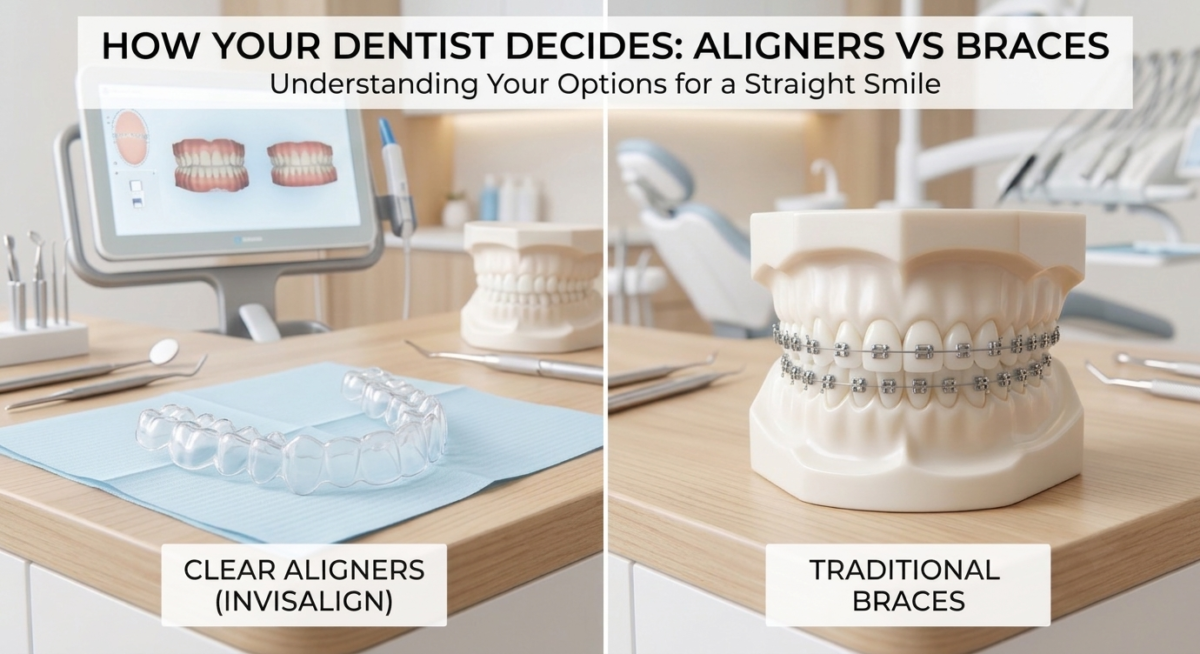
Aligners vs braces is the first question most patients ask when they decide to straighten their teeth. Both treatments correct malocclusion, which is the misalignment of teeth or bite. Clear aligners are transparent, removable trays changed in a numbered sequence. Conventional braces are fixed brackets and wires bonded to the teeth for the full treatment period.
Research comparing the two finds that both work. A meta-analysis of clinical studies found clear aligners shorten treatment duration and move teeth in controlled segments, while conventional braces remain stronger for complex bite correction, torque control and retention. In practice, the deciding factors are the type of correction needed, the patient’s age, daily discipline and budget.
At Dr. Rupali’s Dental Care and Implant Centre in Kasturi Nagar, Bengaluru, the choice is made through a structured evaluation: eight to ten photographs, an OPG X-ray, a lateral cephalogram and a 3D scan. Dr. Rupali Wankhede Panpate, an Invisalign certified dentist with more than 110 aligner cases over 12 years, treats aligner patients from 15 to 70 years of age. This article explains the exact framework she uses, so you know what to expect before your consultation.
Key Takeaways
- Both clear aligners and conventional braces correct crowding, spacing and bite problems effectively.
- Clear aligners suit adults and image-conscious professionals; typical course runs 6 to 7 months.
- Conventional braces are preferred for children below 15 and developmental jaw problems.
- Aligners demand 20 to 22 hours of daily wear; braces need no daily discipline.
- Aligners cost more for long treatments; braces are cheaper for minor corrections.
- The decision follows X-rays, a 3D scan and clinical evaluation, never patient preference alone.
What Are Clear Aligners and Conventional Braces?
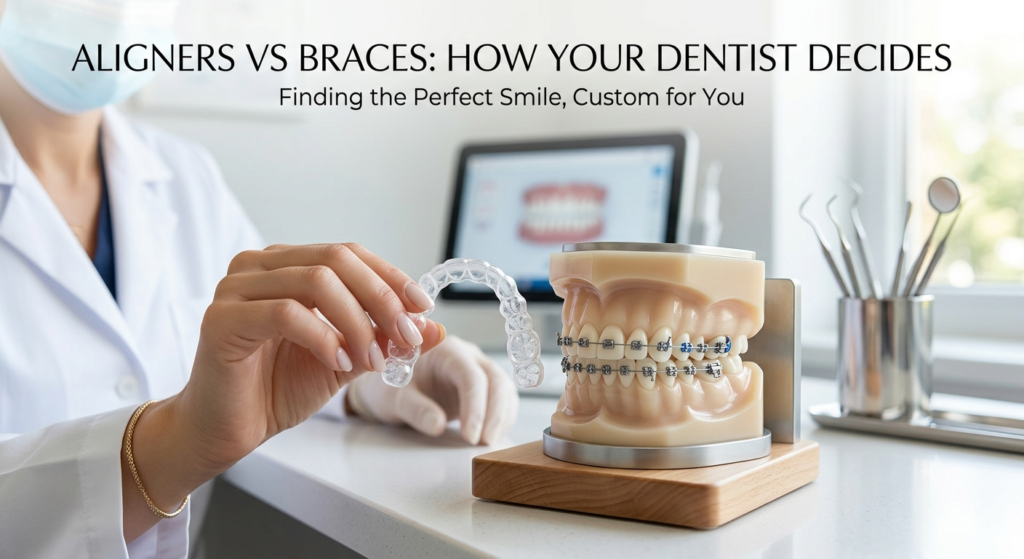
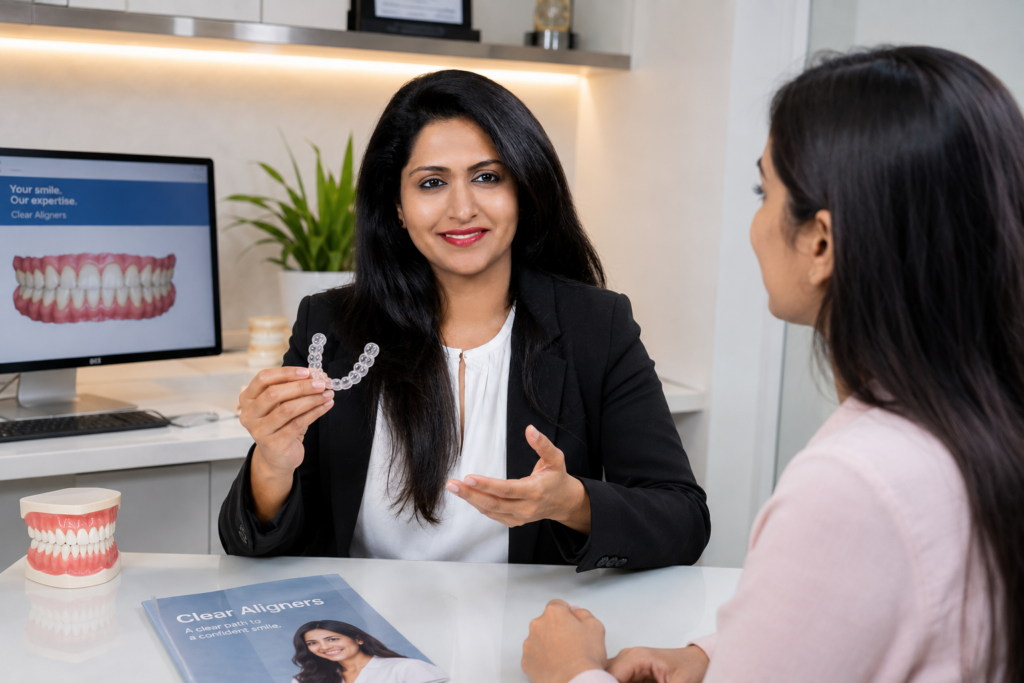
Clear aligners are a series of custom-made, transparent trays produced from a 3D scan of your teeth. Each numbered tray is worn for around 7 or 10 days, depending on the patient’s preferred plan, and moves your teeth a small step before you switch to the next one.
You remove them to eat and brush, then wear them back, keeping total wear at 20 to 22 hours a day. In the case of aligners, the biggest advantage is that there is no pricking of wires against the gums and tissues in the oral cavity. In the case of conventional braces, the fear of wire pricks is always present.
Conventional braces take the opposite approach. Metal or ceramic brackets are bonded to each tooth and connected with an archwire, which your dentist tightens at review visits. Because braces are fixed, they work around the clock without depending on your daily routine.
Both systems apply controlled pressure to move teeth through bone. The difference is not the biology. It is how each system fits your case, your age and your life. The clear aligners service page covers the aligner process in full detail.
Aligners vs Braces: Key Treatment Attributes
| Attribute | Clear Aligners | Conventional Braces |
| Visibility | Nearly invisible | Visible brackets and wires |
| Removable | Yes, for meals and brushing | No, fixed until treatment ends |
| Typical duration (mild to moderate cases) | 6 to 7 months | Longer, varies by case |
| Daily discipline needed | 20 to 22 hours wear, tray changes every 10 days | None, appliance works continuously |
| Food restrictions | None | Hard and sticky foods restricted |
| Best suited age | 15 to 70 years | All ages, preferred below 15 |
| Complex jaw corrections | Not suitable | Suitable, sometimes with surgery |
| Cost position | Premium for longer treatments | Lower for minor corrections |
When Clear Aligners Are the Better Choice
Clear aligners are the stronger option for most working adults with mild to moderate corrections. They fit patients whose appearance matters during treatment, such as professionals in client-facing roles and frequent video meetings. Modern aligners handle spacing, crowding, overlapping teeth, Class 1 and Class 2 malocclusions, open bites and deep bites. Clinical research confirms aligners produce shorter treatment times in non-extraction cases of this kind, which is why a typical course at Dr. Rupali’s Dental Care and Implant Centre runs 6 to 7 months.
The lifestyle argument is real, not cosmetic vanity. There are no wires to catch food, no restrictions on what you eat, and cleaning your teeth stays exactly as easy as before treatment. For patients who maintain gum health during orthodontic work, removability is a genuine clinical advantage, and research links aligners to better periodontal health during treatment.
One condition applies. Aligners only work while they are on your teeth. Miss the 20 to 22 hour daily target repeatedly and the treatment stalls. That trade-off is covered in the discipline section below, because it decides more cases than most patients expect.
When Conventional Braces Are the Better Choice
Conventional braces win in three specific situations, and the first is age. Children below 15 years generally do better with braces, because aligner treatment depends on a daily routine of wear hours and scheduled tray changes that young children find hard to sustain. A fixed appliance removes that risk entirely, which is why it remains the default for developing-age patients. Parents comparing options for younger children can read about the clinic’s kids dental treatment services as the starting point.
The second situation is developmental jaw problems. When the jaw itself has not grown into the correct position, no tray system can fix the foundation. These cases need conventional orthodontic treatment, sometimes with surgical correction first, before any cosmetic alignment is considered.
Systematic reviews of severe malocclusion cases reach the same conclusion: fixed appliances retain the advantage in complex corrections. This is a hard clinical boundary, not a preference.
The third situation is budget with a minor correction. For small spacing or limited crowding, braces can finish the job at a lower cost, while aligners sit in the premium bracket for longer treatments. When the correction is small and the budget is tight, braces are the honest recommendation.
How Dr. Rupali Wankhede Panpate Decides: The Evaluation Process
To recap the comparison so far: aligners vs braces is not a question of which is better overall. Clear aligners suit disciplined adults with mild to moderate corrections who value invisibility and comfort. Conventional braces suit children below 15, developmental jaw problems and budget-limited minor corrections. At Dr. Rupali’s Dental Care and Implant Centre, the final call comes from a structured evaluation, and the sections below cover cost, discipline and the questions patients ask most.
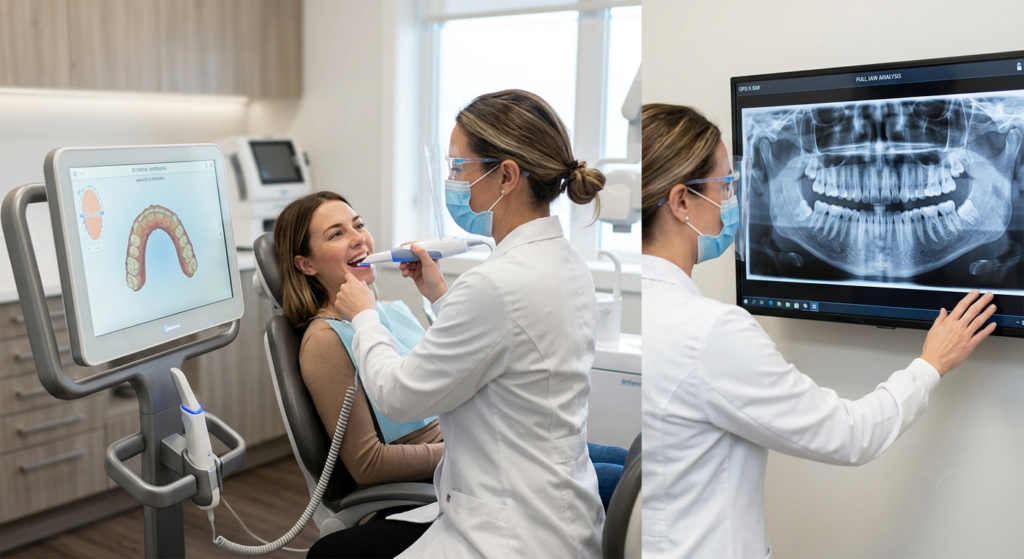
The evaluation itself follows a fixed sequence. First, a discussion of what bothers you and what result you expect, with actual aligner samples shown in the clinic. Second, a gum and hygiene check, because active gum disease or heavy bone loss rules out tooth movement until treated. Cases needing gum work are handled through painless laser gum treatment first, and wisdom teeth are assessed for extraction where they interfere.
Then come the records: eight to ten photographs, an OPG X-ray, a lateral cephalogram and a 3D scan of every tooth. The scan generates a simulation video showing your projected result from four views before you commit to anything. Only after all of this does Dr. Rupali Wankhede Panpate recommend aligners or braces. As she puts it: it is never the patient who decides, it is always the doctor who decides, based on what the evaluation shows.
Cost Comparison: Aligners vs Braces in Bangalore
Aligners cost more than braces for comparable long treatments, and any honest comparison starts there. The gap narrows for small corrections, where braces can be cheaper outright. Exact treatment cost depends on the number of trays or the appliance type your case needs, which is why no serious quote is given before records are taken. At Dr. Rupali’s Dental Care and Implant Centre, the scanning and complete evaluation costs Rs. 3,500 to 4,000, and this amount is adjusted against your treatment cost if you proceed.
Payment structure matters as much as the headline number. Most aligner patients at the clinic use an EMI plan: part payment upfront, the balance in monthly installments. Every review visit during treatment is free, already included in the treatment fee.
Aligner treatment also carries a one year warranty after completion. If your teeth shift within that period, refinement trays are arranged at no cost or minimal cost. Refinements after the warranty are still offered at minimal charges, which protects the value of what you paid.
Discipline: The Deciding Factor Most Patients Underestimate
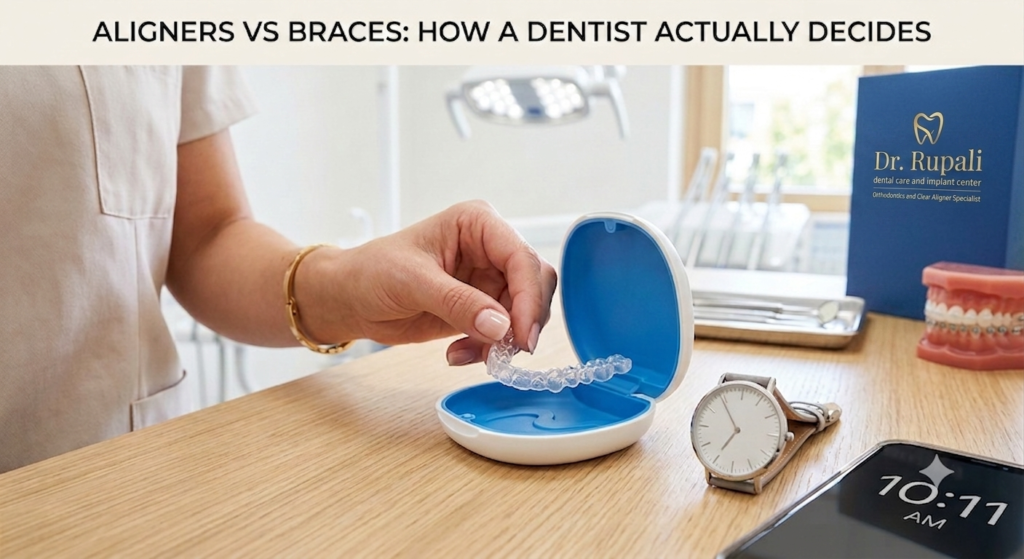
Discipline decides more aligner cases than tooth position does, and patients rarely expect that. Aligners must stay on your teeth 20 to 22 hours a day, with trays changed on schedule roughly every 10 days. A tray worn too few hours will not complete its movement, and the next tray will not seat properly until the current one has done its work. Patients who cannot hold that routine are advised against spending on aligners, however suitable their teeth may be.
The clinic builds a safety net around this. Every 10th day, the team calls active aligner patients to confirm they have moved to the next tray on time. If you miss wear hours, the fix is simple and honest: wear the same tray 2 to 3 extra days to complete its hours before moving on.
Braces ask nothing of your routine. They work continuously whether you think about them or not, which is exactly why they suit children and low-discipline patients better.Incase of conventional Braces exactly after a month visit to clinic is important for tightening of wires or change of wires.Otherwise the braces stop working.So monthly evaluation is very important. Teenagers between 14 and 18 sit in the middle: at Dr. Rupali’s Dental Care and Implant Centre they are assessed together with their parents before aligners are approved. This framework applies at every stage of life from 15 to 70, and the Kasturi Nagar clinic evaluates each case individually.
As Verified By
Independent clinical research supports the framework described in this article:
- A meta-analysis of clear aligner and fixed appliance therapies (Journal of Orthodontic Science, PMC) found aligners shorten treatment duration while braces control torque and retention better.
- A systematic review of severe malocclusion cases (PMC) concluded fixed appliances remain more effective for complicated corrections.
- A 2025 systematic review and meta-analysis (PMC) reported patients prefer aligners for comfort and aesthetics, with case complexity guiding appliance choice.
- The American Association of Orthodontists patient guide on aligners confirms aligners are not right for everyone and the treating doctor recommends the appliance.
- Cleveland Clinic’s guide to clear orthodontic appliances covers the visibility and lifestyle differences between systems.
Frequently Asked Questions
Are clear aligners as effective as braces?
For mild to moderate corrections, yes. Clinical research shows both systems treat crowding, spacing and common bite problems effectively, and aligners often finish faster in these cases.
For complex corrections involving jaw position or severe malocclusion, braces remain more effective. The evaluation X-rays show which category your case falls into.
Which treatment is faster, aligners or braces?
For mild to moderate cases, clear aligners are usually faster. A typical aligner course at Dr. Rupali’s Dental Care and Implant Centre runs 6 to 7 months, and studies confirm shorter durations in non-extraction cases.
Complex cases take longer with either system. Your timeline is confirmed after the 3D scan and X-ray evaluation, not before.
Are aligners more expensive than braces in India?
For longer treatments, yes. Aligners sit in the premium bracket, while braces cost less for minor corrections.
The gap is managed through EMI plans: part payment upfront and the balance in monthly installments. The Rs. 3,500 to 4,000 scanning and evaluation fee is adjusted against your treatment cost if you proceed.
Do aligners hurt less than braces?
Generally, yes. Aligners apply gentle, gradual pressure, and most patients feel only mild tightness for a day or two after each new tray.
Braces involve brackets and wires that can irritate the cheeks and cause an ache after each adjustment visit. Neither treatment involves sharp or lasting pain.
Can teenagers get aligners instead of braces?
Sometimes. At Dr. Rupali’s Dental Care and Implant Centre, teenagers between 14 and 18 are assessed along with their parents before aligners are approved, because the treatment is expensive and depends on daily discipline.
Children below 15 are generally guided to conventional braces, which do not depend on a daily wear routine.
Can I switch from braces to aligners midway?
In selected cases, yes, but it needs a fresh evaluation. New records, a new 3D scan and a new treatment plan are required, because the two systems plan tooth movement differently.
Whether switching makes sense depends on how much correction remains and why you want to change. Discuss it openly at a review visit rather than stopping treatment on your own.
What happens at the consultation before choosing?
The full evaluation sequence: a discussion of your expectations, a gum and hygiene check, eight to ten photographs, an OPG X-ray, a lateral cephalogram and a 3D scan. You then see a simulation video of your projected result from four views.
Only after this does Dr. Rupali Wankhede Panpate recommend aligners or braces for your case. The scanning and evaluation costs Rs. 3,500 to 4,000, adjusted against treatment if you proceed.
The Right Choice Is the One Your Evaluation Supports
Aligners vs braces has no universal winner. Clear aligners reward disciplined adults with mild to moderate corrections: nearly invisible, removable, typically done in 6 to 7 months. Conventional braces remain the right call for young children, developmental jaw problems and tight budgets on small corrections.
What separates a good outcome from a wasted spend is not the appliance. It is matching the appliance to the case, which is exactly what the evaluation exists to do.
Dr. Rupali Wankhede Panpate has treated more than 110 aligner cases over 12 years at Dr. Rupali’s Dental Care and Implant Centre, Kasturi Nagar, Bengaluru, alongside the full range of dental services. To find out which treatment your teeth actually need, call 097390 62002 or book your appointment online.