Skip to the content

Key Takeaways
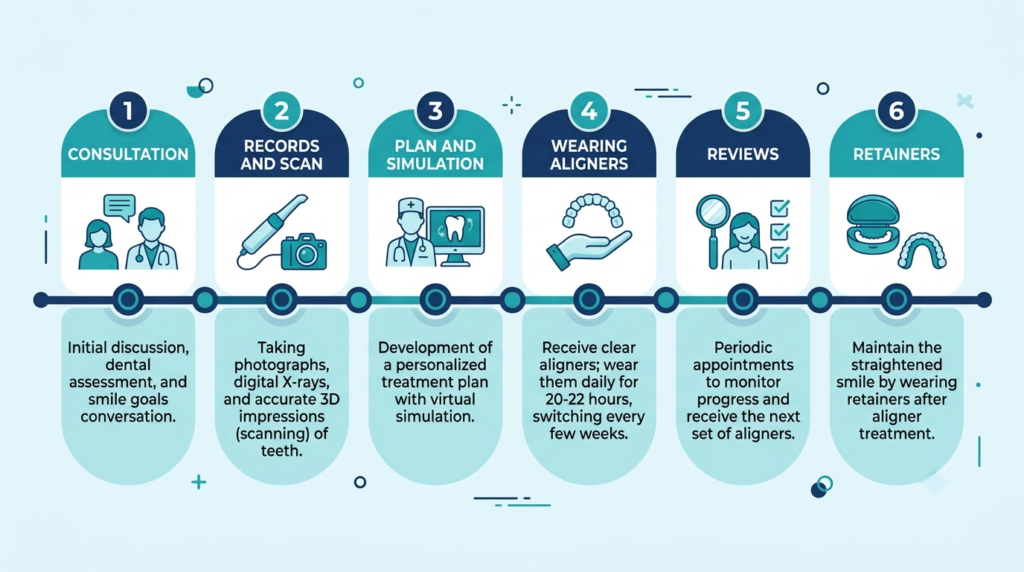
- Clear aligner treatment at our clinic runs in six clear stages, from your first consultation through to retainers.
- A full set of records, including photographs, an OPG X-ray, a lateral cephalogram and a TRIOS 3 digital scan, is taken before any tray is made.
- You see a simulation of your expected result before you commit to treatment.
- Most cases finish in two to nine months, supported by ten-day check-in calls and monthly reviews.
- The scan and complete evaluation cost Rs 3,500 to 4,000, adjusted against your treatment cost if you proceed.
- Dr. Rupali Panpate plans and manages every case personally, and retainers are a mandatory final stage.
If you are considering clear aligners, it helps to know what the road ahead actually looks like. At our clinic, aligner treatment follows a clear, well-worn path, and Dr. Rupali Panpate plans and manages each case personally from start to finish. Here is what to expect, step by step.
It starts with a conversation and a gum check
Every aligner journey begins with a conversation and an examination, not a sales pitch. Dr. Rupali Panpate, an Invisalign approved doctor who plans and manages every case herself, first listens to what you want to change, then checks whether your teeth and gums are ready for treatment. Aligners only move teeth well on a healthy foundation, so if there is any gum inflammation, a cavity to be filled, or cleaning to be done, that is taken care of first. This is also where expectations are set honestly: what aligners can realistically achieve for your case, and roughly how long it is likely to take.
Records and your digital scan
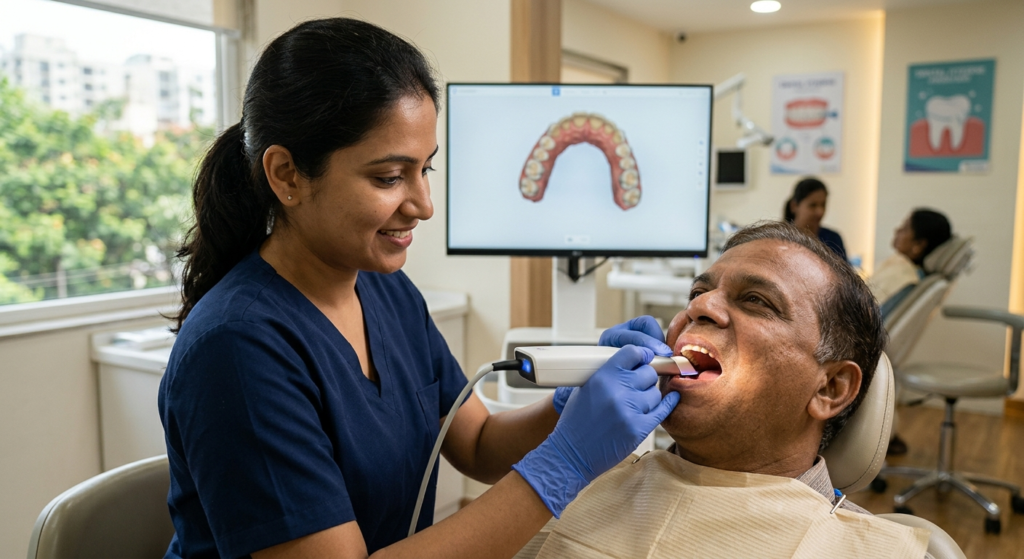
Once your mouth is ready, the clinic takes a complete set of records in a single sitting so the treatment can be planned tooth by tooth. This usually means eight to ten clinical photographs, an OPG X-ray to show the roots and jawbone, and a lateral cephalogram that captures your profile and bite relationship. In place of the old putty impressions, a TRIOS 3 intraoral scanner builds a precise three-dimensional model of your teeth in a few minutes.
Together these records leave nothing to guesswork, which is exactly what accurate tooth movement depends on. If you want to understand the basics first, our guide to how clear aligners work is a good place to start.
Seeing your result before you begin
One of the real advantages of digital planning is that you can see where you are headed before committing to anything. From the scan, a simulation is prepared that shows how your teeth are expected to move from their position today to their final one, and seeing that preview makes the decision far easier. At this stage the system best suited to your case is chosen, either Invisalign or DentCare, along with the number of trays, the likely timeline, and the cost including EMI options.
The scan and complete evaluation cost Rs 3,500 to 4,000, and that amount is adjusted against your treatment cost if you decide to proceed. Most patients begin with fifty to sixty percent of the fee, with the balance spread comfortably over EMI. If cost is on your mind, our breakdown of aligner costs in Bangalore goes into detail.
Life with your aligners

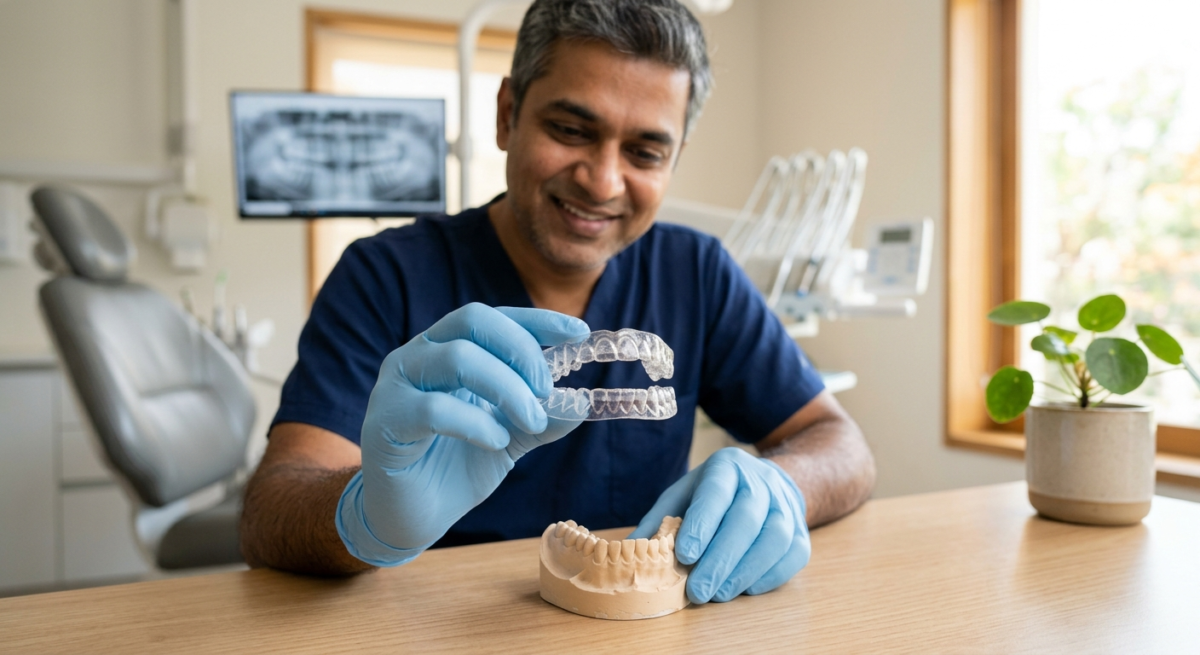
Your aligners arrive as a numbered series of clear, removable trays. Each one nudges your teeth a small, planned amount, and you move to the next tray on the schedule your dentist sets. The trays are worn twenty to twenty-two hours a day and taken out only for meals, for drinks other than water, and for brushing.
For most people the full series is completed in two to nine months, which is considerably quicker than conventional braces, where treatment usually runs about one to one and a half years. Your exact timeline is confirmed for your own case once the evaluation is done.
Check-ins, reviews and refinements
You are never left to manage treatment on your own. The clinic makes ten-day check-in calls to see how you are getting along with each new tray, and you come in for monthly reviews where your progress is measured against your earlier trays. These review consultations are part of your treatment, not billed as extras.
If a particular tooth needs a little more guidance than the plan expected, that is handled under the clinic’s refinement policy, at no or minimal cost within the first year. The goal throughout is the result you saw in the simulation, not simply reaching the last tray.
Retainers to hold your new smile
Moving teeth is only half the work. Once they are in position, the bone and tissue around them need time to settle, and without support they will drift back toward where they started. That is why retainers are a mandatory part of every case here rather than an optional extra.
Your dentist fits your retainers and explains how to wear them so that the result you worked for actually lasts. You can read more in our guide to retainers after aligners.
Book your assessment in Kasturi Nagar
The clearest way to understand your own journey is to have the assessment done. For Rs 3,500 to 4,000, adjusted against your treatment if you go ahead, you leave with a real answer: whether aligners suit your case, how long it should take, and what it will cost including EMI. Call 097390 62002 to book your assessment at Dr Rupali’s Dental Care and Implant Centre, Kasturi Nagar, Bengaluru, and start your journey with aligner treatment at our clinic planned by a dentist who will see it through with you.
Frequently Asked Questions
How long does clear aligner treatment take?
For most cases, clear aligner treatment takes between two and nine months. Simpler corrections finish faster and more complex ones take longer, so the exact timeline is confirmed only after your evaluation. Conventional braces, by comparison, usually run about one to one and a half years.
Does the scan cost extra?
The scan and complete evaluation cost between Rs 3,500 and Rs 4,000. If you decide to go ahead with treatment, that amount is adjusted against your total treatment cost, so it is not an additional charge on top of the fee. You leave the visit with a clear plan and price.
How often will I need to visit during treatment?
You receive ten-day check-in calls after starting each new tray, and you come in for monthly review visits where your progress is compared against your earlier trays. These review consultations are included in your treatment fee rather than billed as extras, so support stays continuous throughout.
What happens after the aligners are finished?
Once your teeth reach their planned positions, you move on to retainers, which are a mandatory final stage of treatment. Retainers hold your teeth in place while the surrounding bone settles, which protects your result and prevents the teeth from drifting back over time.